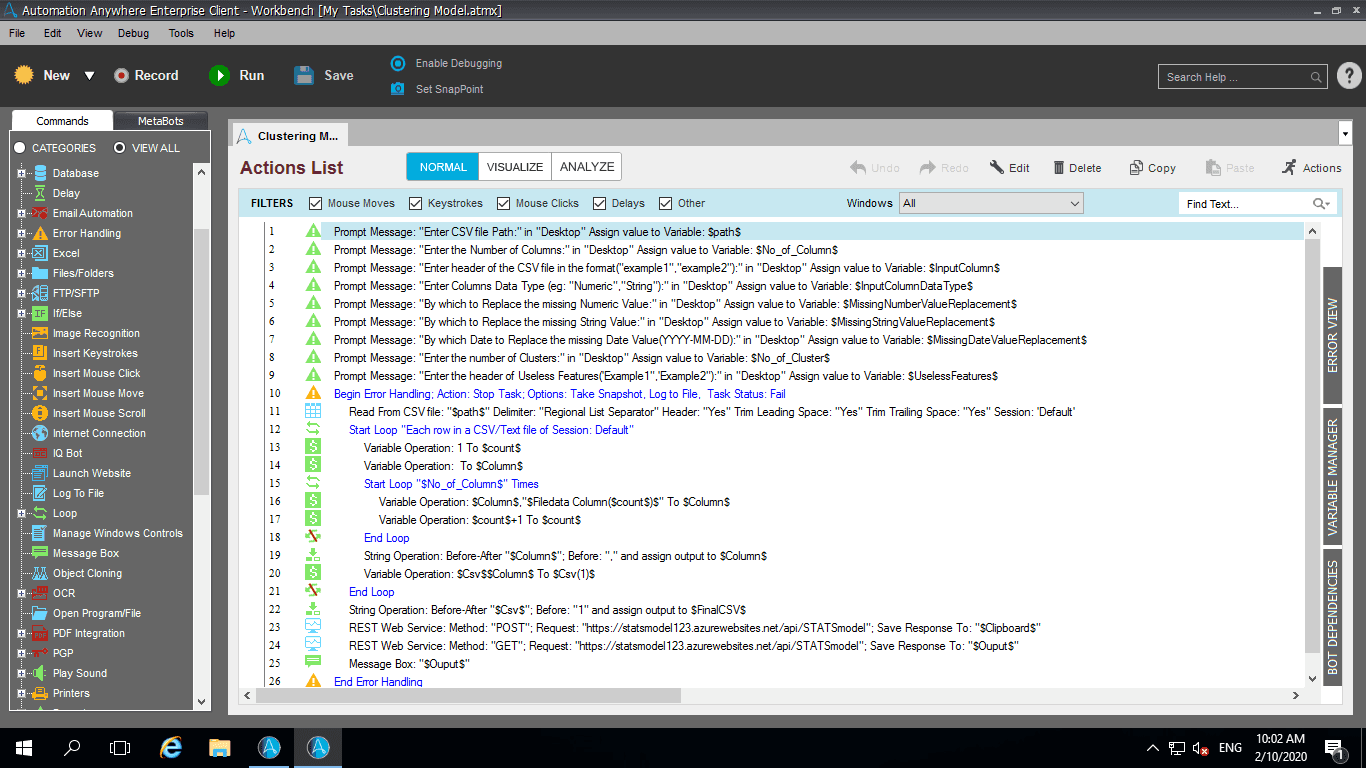
This bot segments customers based on a variety of characteristics to help you identify key groups of customers. This bot enables segmentation of targets with similar traits and assigns them into clusters. Output can be used in a workflow to automate your business processes.
Use Cases:
- Identify the most profitable customers and target them in your marketing campaigns to increase sales per customer.
- Segment your customers by purchase history and their interest to target the right product or service.
- Segment patients based on their medical history and demographic to recruit the right patients for a clinical trial.
Inputs:
- Path: Path of the CSV file. Ex.: C:~Car.csv
- Column Count: Count of columns available in CSV file being provided as input data.
- Input Column Names: Name of columns being provided in CSV file. For example: 'Choice','Hsg2','Coml5'......
- Input Column Data Type: Data Type of columns being provided in CSV file in the same order as column names. For example: 'String','Numeric','Numeric'....
- Missing Number Value Replacement: A value that can be used by Model in case CSV file has blank fields or missing numerical values.
- Missing String Value Replacement: A value that can be used by Model in case CSV file has blank fields or missing string/character values.
- Cluster Count: Count of clusters to be made by the user. For example: 3/4/5 to any user-defined number
- Ignore Columns: Column name that model shall ignore while calculating customer segmentation. For example 'SNo','Range6' to any user-defined input
Actions: The bot takes in the CSV file and performs the customer segmentation and stores the output in an Excel file.
Outputs: Customer Segments
- Output: The result in an Excel file.
- Viable customer segments/personas (5 clusters in the given example) that are cluster output and segmental counts (for unique cluster identification).